MIT and Apache 2.0 are two of the most popular open-source licenses. Both are friendly to developers and businesses — but they are not identical. Here is a simple side-by-side look.
Why this matters
When you use open-source software — or when you publish your own — you are agreeing to a license. A license answers practical questions:
- Can I use this at work?
- Can I change it?
- Can I ship it inside a paid product?
- What text do I need to keep when I redistribute it?
MIT and Apache License 2.0 are both permissive licenses. That means you can use the code in almost any project, including commercial and closed-source products, as long as you follow a few simple rules.
Neither license is copyleft (unlike GPL), so you are not forced to open-source your own changes.
Note: This article is a plain-English overview, not legal advice. For important products, ask a lawyer.
Quick comparison
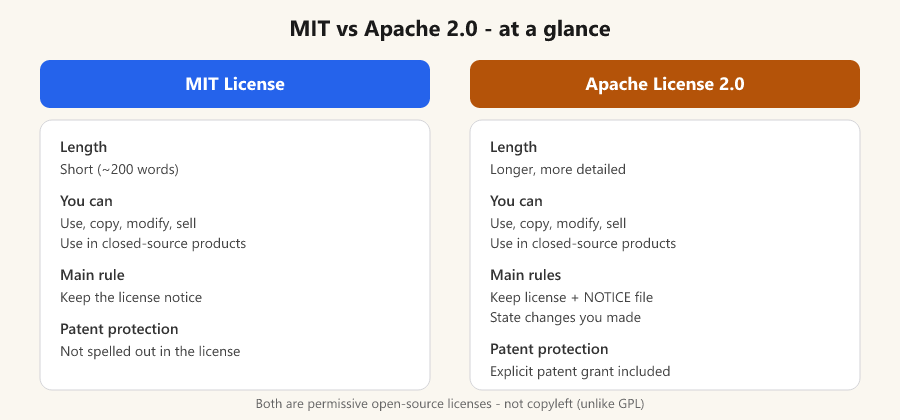
| Topic | MIT | Apache 2.0 |
|---|---|---|
| How long is it? | Very short | Longer and more detailed |
| Commercial use | Yes | Yes |
| Modify the code | Yes | Yes |
| Private / closed-source use | Yes | Yes |
| Must open-source your changes? | No | No |
| Keep license text | Yes | Yes |
| Keep NOTICE file | Not required by MIT itself | Yes, if one exists |
| State what you changed | Not required | Yes, when you distribute modified files |
| Patent language | Not included | Explicit patent grant |
| Trademark protection | Not really addressed | You may not use project trademarks without permission |
MIT License — in simple English
The MIT License is one of the shortest and most popular licenses in open source.
You can:
- Use the software for free
- Copy it
- Change it
- Merge it into your own product
- Sell products that include it
You must:
- Include the original copyright notice and license text when you distribute it
You do not get:
- A warranty (the software is provided “as is”)
- A promise that the authors will fix bugs for you
That is basically it. The simplicity is why so many developers love MIT.
Well-known MIT projects: React, Node.js, jQuery, Ruby on Rails (historically MIT for much of the ecosystem)
Typical MIT notice
When you ship software that includes MIT-licensed code, you usually keep a LICENSE file or an “Third-party licenses” section in your app. A minimal notice looks like:
Copyright (c) 2024 Jane Developer

Permission is hereby granted, free of charge, to any person obtaining a copy
of this software ... (full MIT text)
Apache License 2.0 — in simple English
Apache 2.0 gives you the same freedom as MIT in practice — use, modify, sell — but it adds more legal detail. That extra detail is helpful for larger companies and projects with many contributors.
You can:
- Use the software commercially
- Modify it
- Distribute it
- Place warranty protections on your own product (under your own terms)
You must:
- Include a copy of the license
- Include any
NOTICEfile that came with the project - Mark files you changed (for example, add a comment at the top of a modified source file)
- Keep attribution notices
Apache also includes:
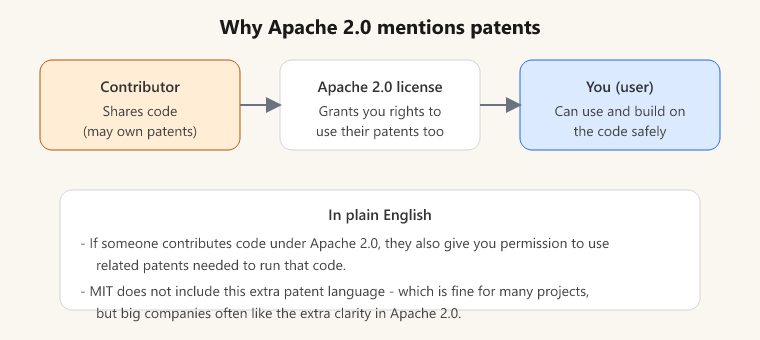
- An explicit patent grant
- Rules about trademarks (you cannot imply the original project endorses you)
Well-known Apache 2.0 projects: Kubernetes, Apache Kafka, TensorFlow, many parts of the Android Open Source Project
What is a NOTICE file?
Some Apache projects ship a NOTICE file listing contributors, attribution, or required credits. If you redistribute the software, you must keep that file. MIT projects sometimes include similar credits, but Apache 2.0 makes it a formal requirement when a NOTICE file exists.
The biggest real-world difference: patents
For most hobby projects and small libraries, MIT works perfectly well.
Apache 2.0 stands out when patents matter. Large tech companies often prefer Apache 2.0 because it clearly says:
- Contributors grant users patent rights needed to use the code
- If someone sues over patents related to the project, they can lose their license to use the project’s code (a “patent retaliation” clause)
MIT does not spell this out. That does not mean MIT is “bad” — it means Apache 2.0 is more explicit, which legal teams like.
What they have in common
Both licenses are:
- Business-friendly — you can build paid products on top of them
- Developer-friendly — low friction for adoption
- Not viral — you do not have to release your private code changes (unlike GPL)
So if you are choosing between MIT and Apache 2.0, you are already choosing a permissive, practical path.
Which one should you pick?
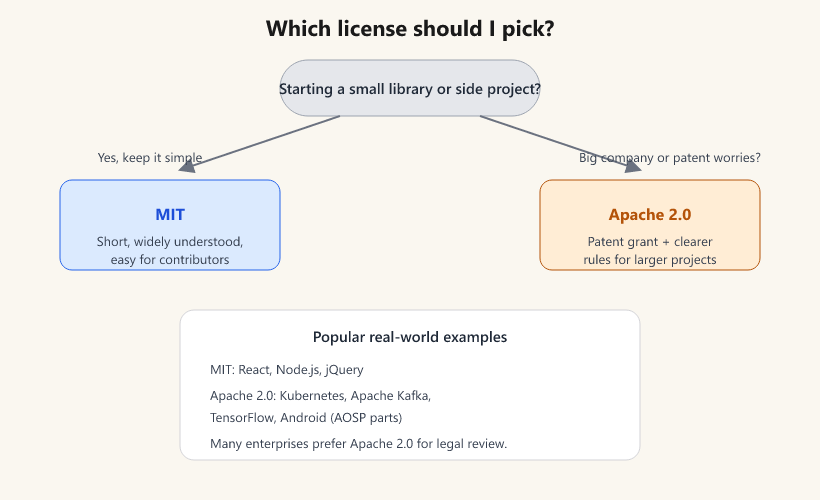
Choose MIT when:
- You want the simplest possible license
- You are building a small library, tutorial repo, or personal tool
- You want maximum adoption with minimal reading for contributors
- Your organization is comfortable with a short license
Choose Apache 2.0 when:
- You expect contributions from companies
- You want clearer patent language
- You are starting a foundation-style or infrastructure project
- Your company’s open-source policy lists Apache 2.0 as a preferred license
Already using one and wondering if you should switch?
Changing a license on an existing project is a community and legal decision, not just a file edit. You typically need agreement from copyright holders. For new projects, pick once at the start and move on.
Compatibility tip
MIT and Apache 2.0 are generally compatible with each other. Many projects combine code under both. Apache 2.0 is also compatible with GPL v3 (MIT is GPL-compatible in many cases too, but always check your specific situation).
When in doubt, read the SPDX license list or your company’s open-source policy.
A one-minute summary
- MIT = short, simple, “keep the license notice, do what you want.”
- Apache 2.0 = same freedom, plus NOTICE handling, change notices, and explicit patent terms.
- Both are permissive and widely used in industry.
- Neither forces you to open-source your own application code.
If you are publishing a weekend library, MIT is a great default. If you are launching something that might land on GitHub’s trending list and attract corporate contributors, Apache 2.0 is a solid, professional choice.
Further reading
- MIT License (OSI)
- Apache License 2.0 (Apache Software Foundation)
- Choose a License — helpful comparison site from GitHub